What 2D, 3D, and 4D actually buy you
Roller dimensions are the most inflated numbers in this aisle. Two of them describe real hardware, one describes a timing trick, and everything above four describes a marketing meeting. Here is what each tier adds and what it costs.
2D: the honest baseline
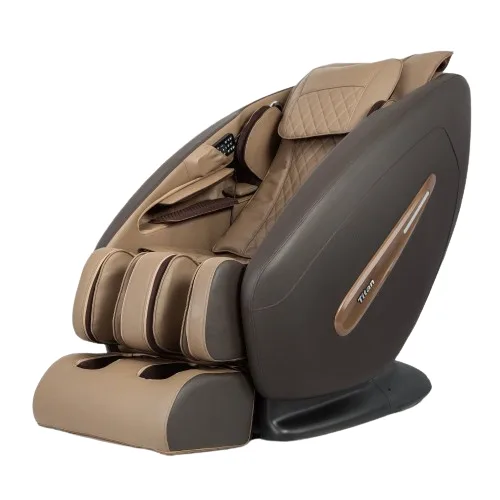
A 2D mechanism moves its rollers along two axes, up and down the track and side to side across the back, at a fixed depth. Pressure comes entirely from the track's shape and your body leaning into it. Kneading, tapping, and rolling all work fine, and the mechanisms run quiet and cheap because there is less to build. Nearly every chair under about $1,500 lives here, whatever the listing implies.
3D: the one upgrade that changes the feel
A 3D mechanism adds the depth axis. The rollers push out toward your back and pull away on command, which turns intensity into a setting instead of a fixed property of the chair. Light-touch users and deep-pressure users can share one machine, and body types the track fits imperfectly still get real contact. This is the mainstream standard from roughly $2,000 to $6,000, and it also survives at the very top: some chairs north of $10,000 run proudly 3D mechanisms, which says something about how much the next number matters.
4D: a timing feature wearing a physics costume
A 4D program varies the rollers' speed and rhythm on the depth axis automatically mid-stroke, with accelerations, pauses, and tempo changes written into the program. The goal is a massage that feels less like a metronome and more like a person, and in the best implementations it does. What it is not: a new direction of movement. One major retailer puts it flatly: there is no actual fourth dimension the chairs are traversing.
Worth knowing before you pay for it: a 3D chair already changes speed from the remote. The 4D badge means the chair changes speed for you.
What "hands-like" claims decode to
Marketing about robot hands compresses three real things. Depth control is 3D hardware. Non-repetitive timing is 4D programming. Real-time reaction is sensor feedback on flagship chairs, where pressure gets measured continuously and the stroke adjusts, and some sellers brand that "5D." Every claim past those three is upholstery.
The label problem, with receipts
No standards body checks these numbers, and the brands prove it. Luraco refuses the 4D label outright and markets its flagship as 3D, arguing in public that only three spatial dimensions exist. Daiwa's Supreme Hybrid runs a 3D six-roller mechanism that some dealers advertise as "6D Dual Track." Human Touch sold the original Super Novo as "3D and 4D" at the same time, and the current version pairs a 3D upper mechanism with a 2D lower one under 4D-branded programs. Panasonic's own pages have called one mechanism 3D in the US and 4D elsewhere. When the same hardware wears three different numbers, the number stops being information.
| Tier | What moves | What you control | Typical price band |
|---|---|---|---|
| 2D | Up, down, side to side at fixed depth | Program and speed | Under about $1,500 to $2,500 |
| 3D | Adds push-in, pull-back depth | Program, speed, and intensity | About $2,000 to $6,000, plus some flagships |
| 4D | Same as 3D | Chair auto-varies speed and rhythm mid-stroke | About $6,000 to $16,000 |
| 5D and up | Nothing new in space | Sensor feedback or dual rollers, defined per brand | Flagship marketing |
How to spend on rollers
Buy the jump from 2D to 3D when your budget allows it, because adjustable depth is the one tier that changes the feel for every person who sits down. Treat 4D as a nice bundle indicator rather than a goal, and treat anything above it as decoration. A longer, better-shaped track with a lower number beats a short track with a big one.
The loser in this comparison is the buyer who pays a four-figure premium for the 4D badge on an otherwise matched chair. The chairs are fine; the reasoning is not.
Roller questions, answered once
Is a 4D massage chair worth the extra money?
Sometimes, though rarely for the D alone. A 4D badge usually arrives bundled with better tracks, heat, and build quality, and that bundle can justify a premium price. Paying thousands more for the badge on an otherwise similar chair is where buyers get burned.
What does the D stand for in 2D, 3D, and 4D?
Dimension. 2D rollers move up, down, and side to side. 3D adds depth, pushing into the body and pulling back. 4D borrows physics language for something that is really a timing feature: the rollers vary their speed and rhythm automatically during a program.
Are 5D and 6D massage chairs real?
The labels exist and the chairs are real, but no fifth or sixth dimension does. Sellers use 5D for chairs with pressure sensors that adjust in real time, and 6D for dual-roller setups. The numbers are not standardized between brands, so compare mechanisms instead.
Can a 3D massage chair change its roller speed?
Yes, from the remote. The only thing a 4D program adds is doing those speed and depth changes automatically mid-stroke, so the massage feels less repetitive without you touching a button.
Keep walking the aisle
Rollers are only half the mechanism; the rail they ride decides what they reach, which is the subject of our track guide, S through SL. For a rare true-3D mechanism under $2,000, see the Titan Pro Commander entry in the best chairs under $2,500, and for the whole decision in order, start at the massage chair buying guide.