S, L, or SL: which track fits your body
The track is the rail the rollers ride on, and it decides more about how a chair feels than any other single part. Retailers hide that behind three letters and a lot of fog, so here is the whole story in plain terms.
The rail underneath everything
Every roller chair moves its massage heads along a fixed rail inside the backrest. The first mass-produced version, built by Fujiiryoki in Japan in 1954, ran the rollers up a straight rail with springs pressing them toward the body. A straight line meets a curved spine badly, so contact came and went as the rollers climbed. Straight tracks are nearly extinct today, though not quite: the Synca Kagra still uses one and compensates by pushing its rollers up to 3.5 inches out to trace the spine.
Three shapes replaced the straight rail, and every modern chair uses one of them or a combination.
The S-track: contour over coverage
An S-track curves the way a spine does, in at the neck, out at the shoulder blades, in again at the lower back. Because the rail itself follows those curves, roller pressure stays even from the base of the neck to the tailbone instead of digging at the peaks and floating over the valleys. Typical length runs 27 to 33 inches, and the massage stops at the lower back.
That endpoint is the whole limitation. An S-track physically cannot reach the glutes or the backs of the thighs, which is where a long day of sitting actually collects.
The L-track: coverage over recline
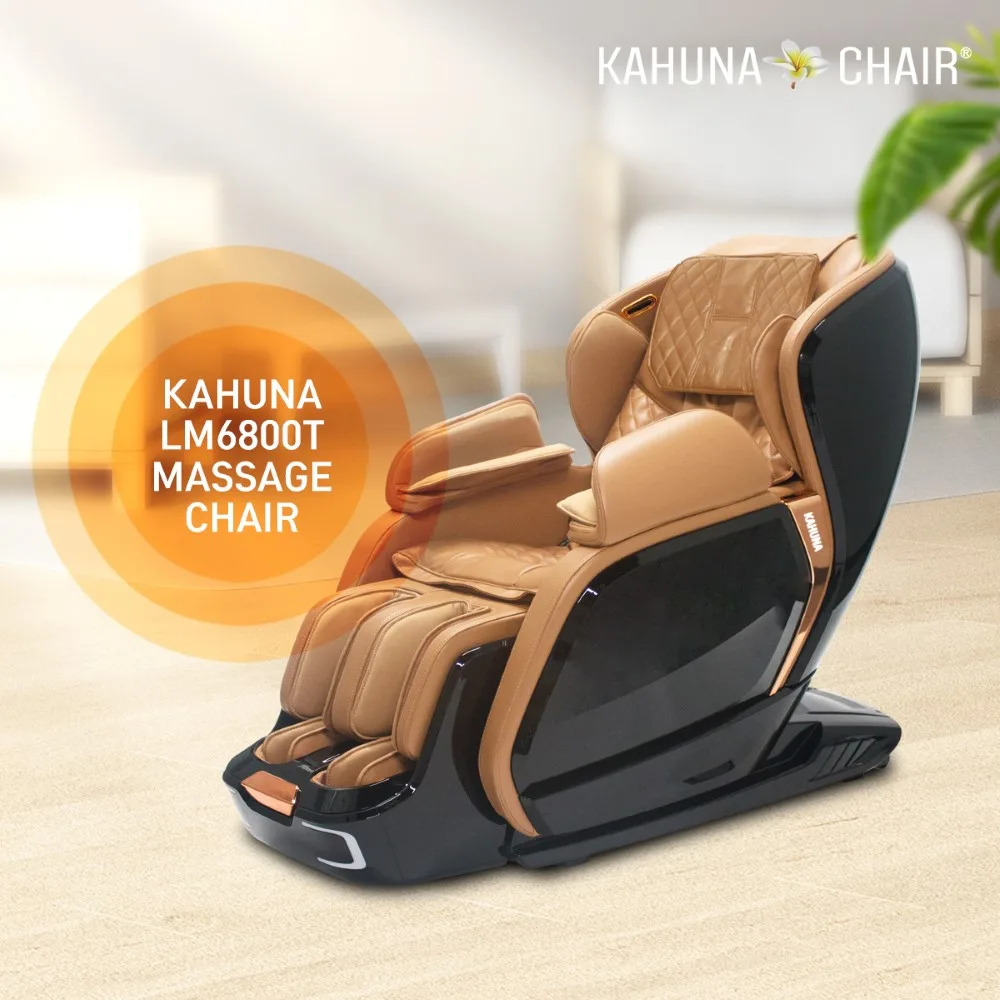
An L-track answers that limitation by extending the rail down and under the seat, adding roughly 10 to 14 inches of travel so the rollers continue through the glutes into the upper hamstrings. Total lengths land between 40 and 53 inches. The classic budget example is the Kahuna LM-6800 family, which built its reputation on delivering that under-seat coverage at a workhorse price.
Two trade-offs came with the shape. Many pure L-tracks run a straighter upper section, so the spinal contouring suffers compared with a good S design. The bigger one involves recline, and it deserves its own section.
The stretch problem, spelled out
A rigid rail that bends under the seat locks the backrest and the seat into a fixed relationship, which means a pure L-track chair can never recline fully horizontal. Stretch programs suffer directly: instead of extending the whole back the way a flat-reclining chair can, the stretch feels like a leg pull from the hips. Chairs built on S-tracks recline flat and run true full-body stretch programs, and that single mechanical fact is why the shape survives at the top of the market.
The SL-track: the default for a reason
An SL-track keeps the S-shaped contour through the neck and back, then continues under the seat like an L. Coverage typically runs 42 to 53 inches, with big-and-tall designs going past 55, and makers advertise it as touching roughly half again more of the body than an S-track alone. Since about 2020 this has become the mainstream design, and when two chairs at the same price differ only here, the SL usually deserves the nod. Watch the label, though: Osaki markets its Maestro LE as a 53-inch SL-track while its own manuals for both generations call the rail L-shaped, which is the kind of gap that decides how much upper-back contour you actually get.
Hybrid and split tracks: the flagship answer
The newest designs refuse the recline trade-off entirely. Daiwa hinges its HybriFlex rail so the Supreme Hybrid reclines past 180 degrees while keeping L-length coverage. Luraco patented a split rail for the i9 Max Plus that runs about 60 inches. Infinity calls its version Flex-Track, and Human Touch builds a unibody S-plus-L shape it calls HT Flex. Different engineering, same goal: glute coverage and a flat, stretch-capable recline in one chair. Expect these only at flagship prices for now.
Length is a supporting stat, not the headline
A longer track only helps a body it actually fits. Roller position is set by the rail, so a user outside the chair's height envelope gets rollers at the wrong vertebrae no matter how long the rail is, and the footrest matters just as much: 6.5 to 8 inches of extension covers average heights, while taller users need around 11. Check the fit range in the technical sheet before the track length impresses you.
Watch the labels
Retail copy blurs these terms constantly. Some sellers use L-track and SL-track interchangeably, a few relabel the family J-track, and the only defense is reading whether the upper section actually follows the spinal curve. When a listing waffles, the spec sheet and a measuring tape settle it.
| Track | Path | Typical length | Reaches glutes | Flat recline | Seen on |
|---|---|---|---|---|---|
| Straight | Vertical rail, spring pressure | Varies | No | Yes | Synca Kagra (rare survivor) |
| S | Follows the spinal curve, neck to tailbone | 27 to 33 in | No | Yes | Panasonic MAK1 |
| L | Down and under the seat | 40 to 53 in | Yes | No | Kahuna LM-6800, original generation |
| SL | S contour plus the under-seat run | 42 to 53 in | Yes | No | Most 2020s mid-flagships, where the maker documents an S contour |
| Hybrid / split | Hinged or split rail, both behaviors | 49 to 60 in | Yes | Yes | Daiwa Supreme Hybrid, Luraco i9 Max Plus |
Which one should you buy
Buy SL as your default in every tier where it exists, because it keeps the contour and adds the coverage. Choose S only when flat-recline stretching matters more to you than glute coverage, or when a back-focused specialist like Panasonic earns it. Go hybrid when the budget reaches flagship territory and you refuse to choose.
The loser here is the pure rigid L-track. In 2026 it survives mostly in older designs, and at any given price an SL usually beats it on contour while giving up nothing on coverage.
Track questions, answered once
Is an SL-track always better than an S-track?
For most buyers, yes, because the SL keeps the spinal contour and adds glute coverage. The exception is stretch: a chair built around a pure S-track can recline completely flat, which some stretch programs need, and Panasonic still builds its top chairs this way on purpose.
How long is a massage chair track?
S-tracks usually run 27 to 33 inches, L and SL designs run about 40 to 53 inches, and split-track flagships stretch to roughly 60 inches. Length only helps if the chair also fits your height, so check the footrest extension too.
Can an L-track massage chair lie completely flat?
A rigid one cannot, because the rail that curves under the seat locks the backrest and seat into a fixed angle. Hybrid and split tracks were invented to fix this: Daiwa’s HybriFlex design reclines past 180 degrees while keeping the under-seat coverage.
What is a J-track?
A marketing name for the same family as the L-track. Treat it as an L-track when comparing chairs, and check whether the upper section actually follows the spine’s curve before assuming it massages like an SL.
Keep walking the aisle
Tracks are half the mechanical story; the other half is what the rollers do while they ride, which we cover in the roller guide, 2D through 4D. To see how track choice fits into the whole purchase, start with how to buy a massage chair, and for the L-track story in the flesh, read our Kahuna LM-6800 review.