Osaki Maestro LE: counting the airbags
This is a good chair with a documentation problem. Reading Osaki's own manuals against Osaki's own marketing turned up three specifications the whole category has been repeating wrongly, all three of which we published ourselves. A fourth correction we published was itself wrong, and we retract it below. The hardware survives the audit. The paperwork does not.
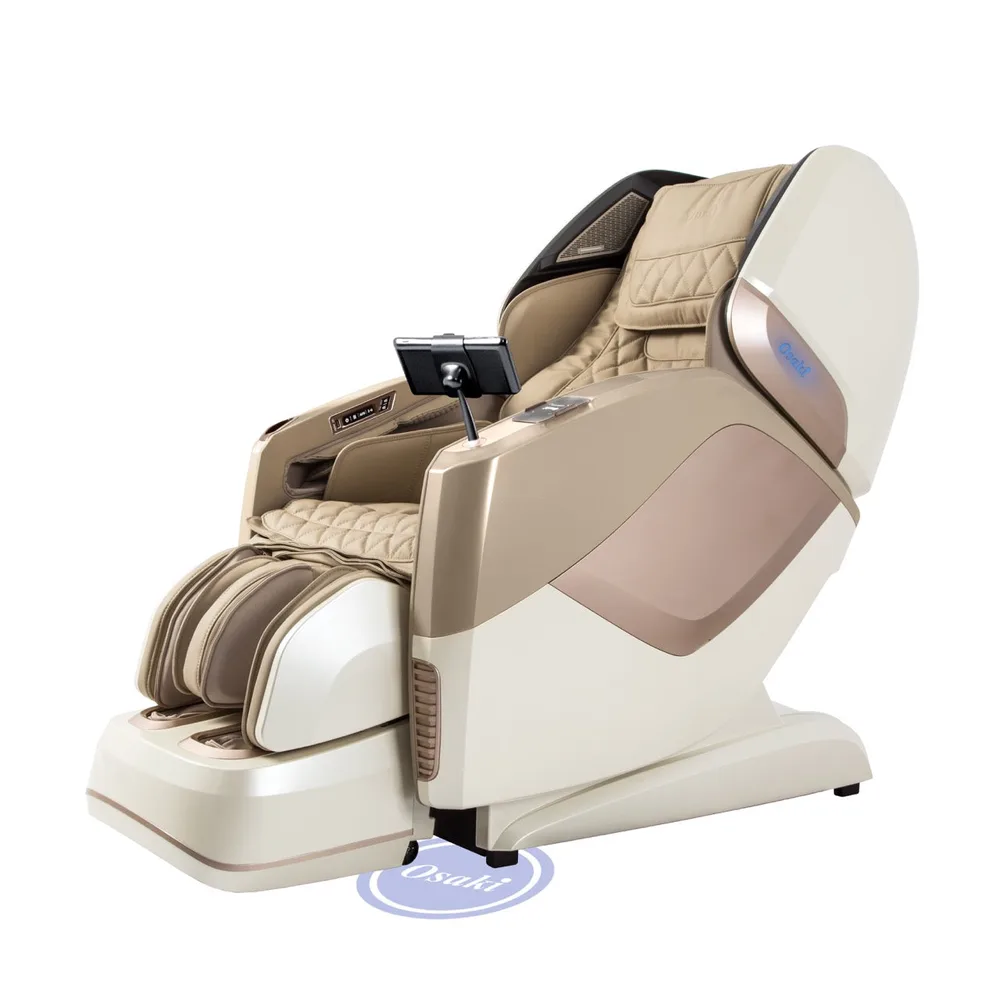
Three chairs have worn the Maestro name. This review covers the original OS-4D Pro Maestro LE, not the plain Pro Maestro and not the Maestro LE 2.0, and Osaki's own manual for this chair is titled for a different one.
95 sources checked · 89 owner reports sampled · verified August 20, 2026
Three chairs, one name, and a manual that makes it worse
Before any specification means anything, you have to know which chair you are holding. Three share this name: the plain OS-Pro Maestro, the OS-4D (rollers that change how deep they press, not just where) Pro Maestro LE reviewed here, and the Maestro LE 2.0 that arrived in 2023. All three are still sold at once, at overlapping prices.
Osaki confuses its own generations in both directions. The original LE's product page offers a user manual download that delivers the LE 2.0's manual. The LE 2.0's product page has no specification content of its own and injects the original LE's spec block instead. And the original LE's genuine manual, which Osaki hosts but links from nowhere, carries the model name "Osaki Pro Maestro 2.0" on its cover and in its spec table. That name means the second generation of the plain Pro Maestro. It does not mean the Maestro LE 2.0. A dealer video published in February 2021 was already calling the original chair a "Maestro 2.0", two years before the real one existed.
What the manual actually says
We downloaded Osaki's own instruction manual for this generation and read the specification table directly rather than trusting any page that summarises it. The guide rail is 52.8 inches and L-shaped. The 4D roller offers eight forward-distance levels across roughly 3.9 inches, with five strength levels and five speeds. Power draw is 250 watts. The chair weighs about 244.6 pounds, stands 61.1 by 31.9 by 48.1 inches upright, and stretches to 79.5 inches reclined. The footrest extends about 7.1 inches, not the 8 the marketing block advertises.
Two numbers in that table deserve their own boxes, because the whole category gets them wrong.
The three-inch claim was ours, and it was wrong
Our earlier review told you this chair needed about three inches of wall clearance, and we repeated it in the spec table, the pros list, the verdict, the FAQ and the body copy, then cited it again on our Luraco review as a comparison. It matches no Osaki document. Both manuals specify 4.7 inches behind the chair, and Osaki's marketing block says five. We have corrected every instance.
The chair is still unusually space-efficient for its class, because it slides forward as it reclines rather than tipping back into the wall. Budget the manual's 4.7 inches behind it and roughly 25 inches of forward travel, and it will still fit a den corner that no full-footprint flagship could.
A correction we got wrong, retracted
We also told you Osaki publishes no user height range at all, and that the 6 foot 4 ceiling we had carried before was a dealer invention. Both statements were false, our own adversarial audit caught them, and we are retracting them the same day we published them. Both manuals do carry a range, 4 feet 9 inches to 6 feet 4 inches with a 260 pound cap, sitting in a Q and A section rather than a spec table. The 6 foot 4 figure was Osaki's own all along.
The mistake was ours rather than the research's. A text search of the manual surfaced safety warnings first, we stopped reading, and we then overruled two research lanes that had reported the figure correctly. What survives is narrower and still worth your time: the number exists, and it appears in no spec table and on no product page, while Osaki's own site FAQ tells buyers to look on the product page to find it.
The warranty, read against itself
Osaki publishes no warranty specific to this chair. The operative text is one brand-class document covering five brands at once, naming no model, and neither generation's manual contains a warranty at all. That document is issued by Titan Chair LLC rather than by anything called Osaki, which is not a red flag by itself: BBB lists Osaki USA as a trading name of Titan Chair LLC, and both operate from the same Carrollton address.
What matters is the gap between the headline and the bullets underneath it. The standard plan is headlined a three-year parts and labour warranty and promises repair or replacement during the first three years of ownership. The bullets grant labour for one year and parts for two. Structural framework is covered for three years "on selected products", and Osaki never publishes which products are selected, so that term is not confirmable for this chair.
Then the part no dealer mentions. The maker's warranty text contains no in-home service provision anywhere. The only mechanism it describes is shipping the chair to a service center under a return authorization, on a machine weighing about 245 pounds that you are also required to package well enough for a carrier to accept. Its single appearance of the phrase in-home is an unedited placeholder telling Osaki's own copywriter to fill in the terms, still sitting in the customer-facing FAQ.
Four further limits belong in front of a buyer. Shipping is the first exclusion listed and is never covered. Coverage is valid only in the 48 contiguous states and Canada. It is non-transferable, stated five separate times, so a resold chair carries nothing. Any commercial use voids it entirely, and so does buying from an unauthorized dealer. There is no upholstery coverage for Osaki chairs at any point, and fabric wear, fading and pilling are excluded by name. Coverage also runs from date of purchase rather than delivery, so freight time comes out of your term.
The good news is real too: Osaki currently bundles its two-year extension free on both generations and sells only that configuration, which works out to three years of labour and five of parts. Most buyers today get the better number. Structural framework still stays at three years no matter which plan you hold.
Parts, and what happens in year six
Osaki publishes no parts catalogue, no part numbers, no prices and no consumer parts store on any of its domains, and neither manual contains a parts list or an exploded diagram. The only goods it sells beyond chairs are cushions and covers. Its published dealer locator renders a placeholder saying the store-locator software failed to load, and there is no technician locator at all.
Parts do exist. Rollers and control boards for this family are obtainable from a specialist seller who publishes what each one costs, which is more than many brands can say. Airbags, upholstery panels, 4D actuator motors and foot rollers are not documented as obtainable anywhere we searched. An independent repair operator names Osaki among its brands and publishes a starting on-site price, but using it carries a real cost: the warranty excludes damage from unauthorized repairs outright.
The federal safety record
We pulled the complete CPSC recall corpus on August 20, 2026 and found no record of any kind for either Maestro LE generation, for the plain Maestro, for any other Osaki-branded product, or for Titan Chair LLC. The result was confirmed in two separate CPSC distributions of the same data, 9,962 records in the REST corpus and 9,964 rows in the bulk export, both spanning June 1973 to August 2026, and the 397-record penalty corpus returned nothing either.
Two consumer incident reports in CPSC's database name Osaki, both listing Titan Chair LLC, and neither concerns a Maestro. Absence of records is not proof of absence, and this one deserves less weight than it looks: across 53 years of recall history, no full-body electric massage chair of this class has been recalled by any brand. Every massage-adjacent recall in the corpus is a handheld unit, a cushion, or a powered recliner. A clean file here is the category norm, not a distinction.
One pattern is worth a buyer's attention, and it belongs to the mechanism rather than the brand: the extending footrest and calf module is the component implicated in the most serious massage-chair incident reports CPSC publishes, across several makers. Keep hands, feet and children clear of the footrest while it travels.
What owners report
We sampled 89 owner reports across the platforms listed at the bottom of this page, and the honest headline is that almost none of them are about this exact chair. A complete ten-year census of the only substantive massage-chair subreddit, 556 posts and 391 comments, plus every comment on all 64 Costco-forum massage-chair threads and keyword sweeps across 40 further subreddits, produced two owners and one showroom trial for the original Maestro LE. Both dedicated massage-chair forums that used to host this discussion are dead at the DNS level.
The single Reddit owner review names three interface complaints, the 15-minute program cap among them. A showroom trial at 5 foot 9 and 170 pounds found it more comfortable than several rivals, and one deal-forum user reports roughly three years of trouble-free ownership. Two independent commenters report the arm-bracket bolt holes not lining up during assembly, one losing about two hours to the eight arm bolts.
The richer owner material describes the predecessor plain Maestro, and under our product identity rule it stays there: a five-year owner reports the chair still reliable with the upholstery still good but the plastic panels creaking, and a four-year owner reports it has grown noticeably noisier while still rating it the best of several chairs tried. Useful for the family, not evidence about this model.
The Maestro LE 2.0 has no owner record at all. Seventeen videos titled for it across seven channels over three and a half years carry zero owner comments between them, and the forum corpus holds nothing. Every piece of LE 2.0 content we could read is seller-produced. That is worth knowing if a dealer steers you to the newer chair on the strength of its reviews.
One caution on service, where our own sources disagree and we are not going to pick a side for you. Negative accounts include a buyer waiting three months for a technician and commenters calling after-sales support nonexistent; the strongest structural evidence is a 2022 thread asking who to call for an Osaki repair that has since grown into a de-facto help desk with 96 archived comments. Positive service accounts sit in the same corpus.
Known issues
- Recurring owner complaint
The warranty a buyer thinks they have is not the warranty the maker's document describes.
Osaki's standard plan is headlined three years of parts and labour while its own bullets grant one year of labour and two of parts; the text provides no in-home service at all, only ship-in under a return authorization; structural framework stays at three years even on the extended plans; and coverage is void outside the 48 contiguous states and Canada, void on resale, and void on any commercial use. Major dealers restate the same warranty with in-home labour that the instrument does not contain. This is documented across four separate Osaki-issued instruments rather than inferred.
- Recurring owner complaint
Post-sale service responsiveness is the recurring complaint against the seller, though none of it names this chair.
BBB records 26 complaints closed against Titan Chair LLC, trading as Osaki USA, in the last three years, with warranty-ticket latency and dropped tickets recurring from 2023 through 2026 alongside disputes over used-versus-new replacement parts. Independently, a 2022 Reddit thread asking who to call for an Osaki repair has grown into a de-facto help desk with 96 archived comments. Our own owner-evidence lanes conflict here: positive service accounts exist in the same corpus. None of the 23 published complaints we read names either Maestro LE generation.
- Isolated report
Arm-bracket bolt holes may not line up during assembly.
Two independent commenters report the same problem on the original LE, one spending roughly two hours on the eight hex bolts for the arms alone. Two reports is a thing to expect rather than a defect we can call established.
- Isolated report
The chair stops itself at 15 minutes, and one owner finds that short.
Both manuals specify a 15-minute working time in the spec table, so this is documented rather than reported. The single Reddit owner review of this chair names the 15-minute program cap among three interface complaints. Almost no review in the editorial channel mentions it at all.
- Isolated report
Larger users may run out of backrest, on the family's only large-user report.
At 6 foot 1 and 240 lb, an owner of a Maestro-family chair reports the backrest topping out about three inches below his shoulders with no neck or head support. He sits inside Osaki's published 6 foot 4 height range but above its 260 lb weight cap. A separate showroom trial at 5 foot 9 and 170 lb found the chair comfortable.
The spec sheet
| Track | Manual says L shape, 52.8 in; marketed as SL |
|---|---|
| Rollers | 4D, 8 depth levels over about 3.9 in |
| Intensity | 5 strength levels, 5 speeds, 5 airbag levels |
| Airbags | 20 per the manual diagram, not the 32 advertised |
| Heat | Heated back rollers only, on or off, no zones |
| Session cap | 15 minutes, then the chair stops itself |
| Fit | 4'9" to 6'4", 260 lb max, per the manual Q and A |
| Clearance | 4.7 in behind, about 25 in of forward slide |
| Upright | 61.1 x 31.9 x 48.1 in |
| Reclined | 79.5 x 31.9 x 46.9 in |
| Weight | About 244.6 lb |
| Power | 110 to 120V, 250W |
| Warranty | Sold as 5 yr; instrument gives no in-home service |
How it grades out
| Pressure control | Very goodA genuine 4D mechanism with eight forward-distance levels, five strength levels and five speeds, all documented in Osaki's own spec table rather than badge-engineered. |
|---|---|
| Room efficiency | Very goodThe slide-forward recline needs 4.7 inches behind the chair per the manual, which is genuinely small for a flagship-class footprint, even though it is more than the 3 inches we and others published. |
| Ease of use | GoodA touchscreen tablet remote with a shortcut panel beats the wand controllers common in this class. Held back by a 15-minute session cap, no memory slots and no app. |
| Warranty | FairWhat Osaki sells today is a bundled five-year configuration, which is respectable. The underlying instrument provides no in-home service, caps structural framework at three years on every plan, excludes upholstery entirely, dies on resale and on commercial use, and does not reach Alaska, Hawaii or Puerto Rico. |
| Serviceability | FairDocumented service is ship-in under a return authorization, on a chair of about 245 lb. The dealer locator does not function, there is no technician locator, and no out-of-warranty labour rate is published anywhere. |
| Parts availability | FairNo parts catalogue, part numbers or prices from Osaki, and no exploded diagram in either manual. Rollers and control boards are obtainable from one specialist marketplace seller; airbags, upholstery, 4D motors and foot rollers are not documented as obtainable at all. |
| Build confidence | GoodNo CPSC record of any kind, and prior-generation owners report multi-year reliability. Tempered by creaking panels and rising noise reported on the predecessor, and by an assembly fit complaint on this generation. |
| Fit range | GoodOsaki publishes 4 foot 9 to 6 foot 4 and 260 lb in both manuals' Q and A, which is a real documented envelope, though narrower at the top than several rivals. Marked down because the figure is absent from every spec table and product page, so most buyers never find it. |
| Value | GoodA documented 4D mechanism with heated rollers well below flagship money. Undercut by the fact that Osaki's own store prices this superseded chair above its replacement. |
Massage quality and noise are ungraded: the owner pool for this exact generation is too thin to grade the first, and we located no noise report on it in either direction.
A real 4D mechanism below flagship money
The hardware holds up and the recommendation follows it. A genuine 4D mechanism with heated rollers, a slide-forward recline that really does fit a corner, and a touchscreen remote add up to a lot of chair below flagship money, CPSC has nothing on it, and its published envelope of 4 foot 9 to 6 foot 4 and 260 pounds is stated by the maker rather than invented downstream. Buy it with the shopping instruction attached, because Osaki's own marketing overstates the airbag count and the track shape against its own manuals, hands owners of this generation the wrong manual, and its store has been seen selling this superseded chair above its own replacement. Check the newer generation's price the same day, get any in-home service promise from the dealer in writing, and take this one when the older chair prices below the new one.
Listing checked August 20, 2026. Confirm the seller is an authorized dealer before buying: coverage is void on purchases from unauthorized dealers, and it is non-transferable, so a resold chair carries none.
Owner base: 89 reports sampled (YouTube owner comments 47, Reddit and deal-forum owner accounts 15, BBB complaints and customer reviews 27, as of August 20, 2026).
Maestro LE questions, answered once
How many airbags does the Maestro LE actually have?
Twenty. Both generations' manuals itemise the same layout in an Air Bags Massage Position diagram: two at the shoulders, twelve across the arms, seat and waist, and six at the legs and feet. Osaki's marketing block claims 32, and that sentence is inherited word for word from the plain Pro Maestro's spec block, where it still names a different chair. Most of the dealer channel copied the 32.
Is the Maestro LE an SL-track or an L-track chair?
Osaki markets it as a 53-inch SL-track. Osaki's own engineering spec table, in both generations' manuals, calls the guide "L Shape 52.8 inches", and the term SL-track appears nowhere in either document. Osaki's own product record even tags the original chair L-TRACK. The distinction matters because an L rail and an S-plus-L rail contact the upper back differently, so do not assume the S half exists on the strength of the label.
How tall can you be and still fit the Maestro LE?
Osaki recommends 4 feet 9 inches to 6 feet 4 inches, with a 260 pound maximum, and both generations' manuals say a user outside that range will not fit comfortably and may be injured. The catch is where the figure lives: the Q and A section of the manual, never the spec table and never a product page. Osaki's own site-wide FAQ tells buyers to check the product page for a recommended height range, and no product page carries one, which is why dealers publish their own invented numbers.
Does the Osaki warranty include in-home service?
Not in the maker's document. The only mechanism the warranty text describes is ship-in: you obtain a return authorization number and send the chair to a service center. The single place the phrase in-home appears on Osaki's warranty page is an unedited placeholder in the customer FAQ, instructing the site's own copywriter to fill in the real terms. Several major dealers promise in-home labour anyway, so get any such promise from your seller in writing.
Should I buy the Maestro LE or the Maestro LE 2.0?
Check both prices on the day, because the older chair is often the more expensive one. At Osaki's own store the superseded original lists above the newer 2.0. The 2.0 genuinely adds voice control and a palm-sensor body scan, and its 4D roller reaches deeper over seven levels where the original steps finer over eight. Track, dimensions, angles and the 20-airbag layout are identical, so it is not the wholesale upgrade the reviews imply.
95 sources checked · 89 owner reports sampled · verified August 20, 2026
- 47YouTubeowner comments
- 15Redditowner threads and replies
- 27BBB complaintscomplaints and reviews we read
Primary documents
- osakiusa.com, pages: warranty
- Official product page, original OS-Pro Maestro LE
- Official product page, Maestro LE 2.0
- osakiusa.com, pages: warranty inquiry
- Shopify product record for the original LE, source of SKUs and GTINs
- Shopify product record for the LE 2.0, whose body_html points at the ORIGINAL LE spec block
- osakiusa.com, products: osaki 4d maestro le 2 0
- osakiusa.com, products: osaki os pro maestro 4d
- The Osaki-authored spec block that both generations’ product pages inject, source of the 32-airbag and 5-inch clearance claims
- Maestro LE 2.0 manual, 36 pages, downloaded and text-extracted; served from the ORIGINAL LE product page as its user manual
- Plus 27 more primary sources in this product's evidence ledger
Owner report pools
- YouTube owner comments, across both Maestro LE generations: 69 reports located, 47 read, as of August 20, 2026
- Reddit and deal-forum owner accounts, Maestro family: 15 reports located, 15 read, as of August 20, 2026
- BBB complaints and customer reviews, Titan Chair LLC trading as Osaki USA: 30 reports located, 27 read, as of August 20, 2026
Regulatory databases checked: CPSC recall corpus, penalty corpus and SaferProducts.gov incident database, swept with positive controls; CPSC.gov's own recall search interface, which was non-functional from this environment. Archive.org is blocked from our research environment, so archived-copy links are omitted until they can be independently verified.
20 more we opened and could not read (dealer pages, dead links and blocked stores, listed in full)
media.tractorsupply.com, is/content/TractorSupplyCompany/tsc/product/1/97/37/60: 1973760 War1; osakiusa.com, pages: warranty issue; osakiusa.com, pages: osaki massage chair faq; osakiusa.com, pages: compare massage chairs; play.google.com, store/apps: details; apps.apple.com, us/app/pro-maestro: id1411143529; osakimassagechair.com, pages: assembly tutorial osaki; parts.massagechairi.com, site root; osakimassagechair.com, pages: service request; easymassagechair.com, osaki os 4d pro maestro le sl track massage chair factory certified...; osakiusa.com, pages: contact us; themodernback.com, blogs/news: osaki 4d maestro le 2 0 massage chair review; osakimassagechairs.com, products: osaki os 4d pro maestro le massage chair; titanchair.com, products: osaki 4d maestro le 2 0 massage chair; massagechairrelief.com, products: osaki maestro le massage chair; easymassagechair.com, blog: osaki maestro le 20 your personalized massage oasis; shopsaloncity.com, products: osaki 4d maestro le 2 0; johnsonfitness.com, Osaki 4D Maestro LE 20 Massage Chair P39125; massagechairforum.com, site root; massagechairtalk.com, site root.
Manufacturer contact: Questions drafted August 20, 2026 and not yet sent at publication. No manufacturer response is represented in this review.
- August 20, 2026 Verdict recalibrated against the published v1.1 definition, which sets BUY at no major disqualifier for the intended user with evidence behind it. The prior CONSIDER applied every documentation flaw in a maker's paperwork to every buyer, which is not what the scale says and not what this ledger found. No grade, source, figure or finding changed in this pass; the call and its wording did.
- August 20, 2026 Migrated to the v1.1 evidence protocol. Four corrections to our own earlier review, all verified against Osaki's own manuals: wall clearance is 4.7 inches and not the 3 inches we published in five places; the airbag count is 20 and not 32; Osaki's manuals call the rail L-shaped rather than the SL-track we and the channel repeated; and the user height range is published where almost nobody looks, in the manual's Q and A rather than any spec table. Adds the ship-in-only warranty finding, the in-home placeholder, the structural-framework cap, the 15-minute session limit, the CPSC sweep result, the Titan Chair LLC corporate identity, and the two-way manual and spec-block mixup between generations.
- August 20, 2026 Correction to our own correction, same day. We published that Osaki states no user height range anywhere and that the 6 foot 4 ceiling we had cited was a dealer invention. Both manuals do publish 4 foot 9 to 6 foot 4 with a 260 lb cap, in their Q and A section, and our adversarial audit caught it. The error was ours: a text search of the manual returned safety warnings first and we concluded absence without reading further, then overruled two research lanes that had reported the figure correctly. Every affected line on this page, in the spec check, the grades, the FAQ, the rail and the hub card has been corrected.
Keep walking the aisle
This chair appears in our ranking of chairs whose makers publish a weight limit at all, chairs ranked by verified wall clearance. See where it places against every chair we have read in the best massage chairs ranking. See how the rail shape changes the massage in the track guide, weigh the 4D badge in the roller guide, or compare the warranty against the tier above in our Luraco i9 Max Plus review.