Glide pads or a roller track in the living room
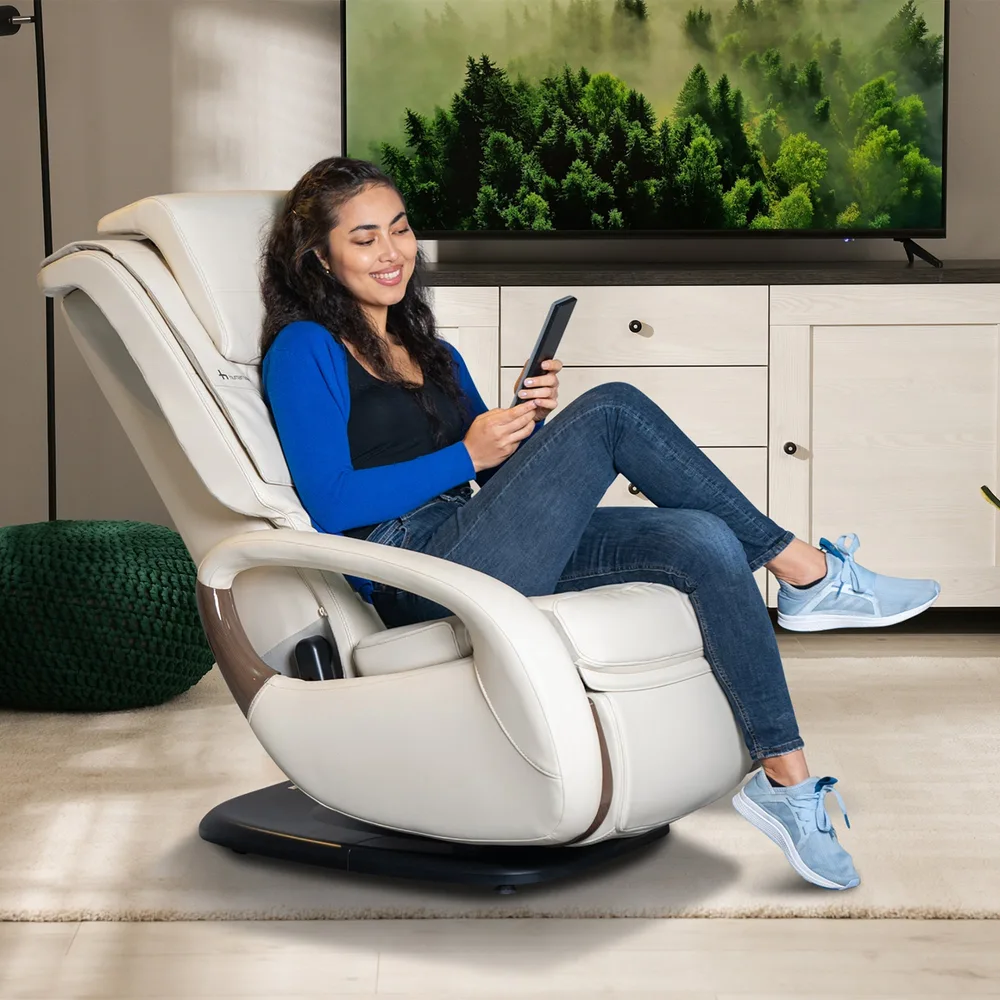
Pick a massage chair for your back and you annoy your living room; pick one for your living room and you shortchange your back. That fork sums up the Human Touch WholeBody 8.0 against the SL-track field. Human Touch sells the one chair in the $1,500 to $2,500 bracket that looks like furniture, swivels, and moves without a hand truck, while every SL-track rival out-massages it from the neck down. This comparison sorts out which side of the trade you are actually on.
What the SL-track side does better
An SL-track chair runs rollers along a curved rail from the base of the skull, down the spine’s contour, then under the seat to the glutes and upper hamstrings, typically 42 to 53 inches of travel. That under-seat reach explains why the design took over the market, because a chair without it works your back and then stops at the belt line.
Zero gravity comes bundled. Chairs like the Kahuna LM-6800T and Osaki OS-Champ tilt you into a knees-above-heart recline, usually across two or three positions, and pair it with body scanning, air compression, foot rollers, and long program lists. The LM-6800T even ships fully assembled. Feature for feature, the SL-track side wins so decisively that this comparison would end here if massage specs were the only question.
What the WholeBody 8.0 does that no track chair can
Human Touch spent the same budget on entirely different problems. The 8.0 is shaped and upholstered like a conventional recliner, weighs 114 pounds against roughly 200 for a chair like the LM-6800T, and pivots on a 55-degree swivel base so it can face the television or the couch as the evening demands. Its CirQlation calf massager flips over and disappears into an ordinary ottoman. Guests will sit in it without asking what it is.
The massage itself comes from FlexGlide orbital pads working the back, neck, and shoulders, a gliding motion owners describe as gentle rather than deep. Warm air heat and seven auto programs round it out, steered by a BodyMap remote instead of an automatic scan. One spec swings hard in its favor: the 8.0 carries users up to 285 pounds, while the SL and L-track chairs in this bracket stop between 200 and 240. MYNTA’s MC4100 caps at 200, the OS-Champ at 220, the LM-6800T at a reported 220 to 230, and the Titan Pro Commander at 240.
Side by side
| Spec | WholeBody 8.0 | Typical SL-track rival |
|---|---|---|
| Coverage | Back, neck, shoulders, calves | Neck to glutes and hamstrings |
| Mechanism | FlexGlide orbital glide pads | Rollers on a 42 to 53 inch rail |
| Zero gravity | None | Usually two or three positions |
| Body scan | No, manual BodyMap remote | Common at this price |
| Looks | Conventional swivel recliner | Equipment pod |
| Weight capacity | 285 lbs | 200 to 240 lbs |
| Moving it | 114 lbs, one person can shift it | Around 200 lbs, stays put |
Who should not buy the WholeBody 8.0
Be clear-eyed before the upholstery wins you over. Anyone shopping because their lower back, glutes, or hamstrings ache after long days should walk past this chair, since it has no mechanism below the waist beyond the calf unit. Deep-pressure fans will find the FlexGlide motion too polite, and there are no rollers to dial deeper. Nappers chasing that weightless zero gravity float will not find it here either. On every one of those counts the 8.0 loses outright, and the honest move is an SL-track chair like the LM-6800T instead.
Shoppers wanting both furniture looks and full-body coverage should know that combination does not exist in this bracket. Hybrid-track chairs such as Human Touch’s own Super Novo chase both goals at once, but they live several price tiers up.
How to make the call
Start with the room, because the room does not compromise. A track chair needs a footprint around 3 by 5 feet upright and closer to 3 by 6.5 feet reclined, plus wall clearance anywhere from a couple of inches on space-saver designs to well over a foot on traditional ones, and once placed it stays. The 8.0 occupies a normal recliner’s footprint, swivels to face whatever matters, and hides its hardware when guests arrive.
Then weigh the body sitting in it. A user over 240 pounds picks the 8.0 by default, since the track-chair field in this bracket turns them away. A user chasing relief below the belt line picks the SL track by default. Households split down the middle should ask which purchase gets used a year from now: a striking machine the sensitive spouse avoids, or a gentle recliner the enthusiast finds boring. Whichever chair the household will actually sit in every evening is the one that belongs in the living room. If that is the 8.0, it is a competent chair with a 285 pound rating three Human Touch documents agree on, and it needs only nine inches behind it.
Questions, answered once
Can an SL-track massage chair pass as living room furniture?
Not in the under-$2,500 bracket. The rail, footwell, and shell shape make SL-track chairs read as equipment, which is exactly the gap the WholeBody 8.0 was built to fill.
How much floor space does an SL-track chair need compared to the 8.0?
Plan on roughly 3 by 6.5 feet when an SL-track chair reclines, plus wall clearance that ranges from a couple of inches to over a foot depending on the design. The 8.0 uses a standard recliner footprint and swivels in place.
Is zero gravity worth giving up furniture looks?
For people who nap or lounge in the chair daily, usually yes, since the reclined position takes weight off the body in a way a flat recline cannot match. For a chair used a few times a week in a shared room, looks tend to win the argument.
Which chair wins for users over 240 pounds?
The WholeBody 8.0, and by default. Its 285-pound rating clears every SL and L-track rival in this price range, which cluster between 200 and 240 pounds.