Getting a red light panel positioned right
Nobody budgets attention for the mounting question until the box is open and the panel is leaning against a wall. Brands photograph their panels floating at chest height in bright white rooms, then ship a door hook and a length of rope. What each panel actually includes for positioning varies more than almost any other part of the purchase, and the gap between a 4.8-pound compact and a 25-pound tower changes what your walls, doors, and budget have to absorb. Here is what the hardware situation really looks like across the popular models, and how to plan placement before you spend.
The box rarely matches the marketing photo
Compact panels in the 60-LED class weigh between 4.8 and 6 pounds and ship with self-contained solutions: a kickstand, or a door hook with an adjustable rope. Towers in the 200-to-300 LED class weigh 20 to 25 pounds and typically include a hanging kit, with proper floor stands sold separately. Read the included-accessories list on any panel before buying, because the same money buys very different setup experiences.
One universal bright spot: protective goggles ship in the box with most mainstream panels, including Hooga’s HG300, Bestqool’s BQ60, and Wolezek’s tripod lamp kit. Session timers are effectively standard now too, from budget inline controllers up to touch panels, so at least the electronics side of setup takes care of itself.
Tabletop panels are the easy case
The Hooga HG300 is the template for zero-effort placement. It measures 12.2 by 8.2 inches, weighs 6 pounds, and has a built-in swing-out kickstand, so it props up on any desk or table like a picture frame. No hardware, no hanging, no thought.
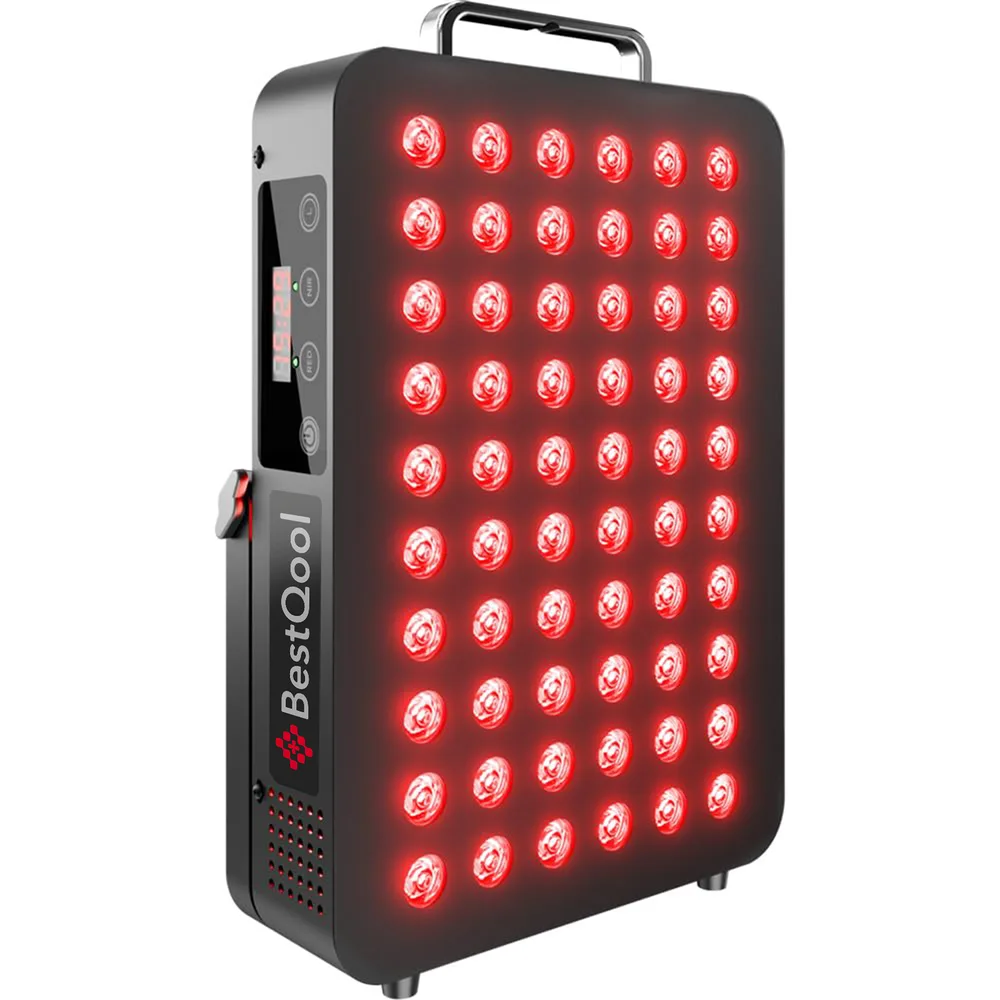
The Bestqool BQ60 takes the other compact route. It ships with a door hook and an adjustable rope, and owners describe using it upright, laid flat, angled, or door-hung. At 4.8 pounds any interior door handles it without complaint. The catch is that Bestqool offers no mobile stand for this model, so mid-room placement at standing height is not an out-of-the-box option.
Keep coverage numbers in mind when planning a tabletop setup. Bestqool documents the BQ60’s coverage at 17.2 by 11.8 inches from 6 inches away, which is face-and-shoulders territory. A compact panel on a desk works because the target area is small; the same panel aimed across a room spreads weak, diffuse light over a big area and does the spec sheet no justice.
Hanging a tower is a hardware project
Tower panels change the math. Mito Red Light’s own spec table puts the 200-LED MitoMAX 2.0 at 20 pounds and the 300-LED MitoMEGA at 25 pounds, both in roughly 36-inch-tall housings. A door hook that shrugs off a 5-pound compact is a different proposition under 25 pounds of metal and glass swinging every time the door moves.
If you plan to door-hang a tower, check the kit’s rated capacity, use a solid-core door, and consider over-door brackets rated for the load. Wall mounting into studs is the sturdier long-term answer, though it costs you the ability to move the panel between rooms. Whatever the anchor, a 36-inch column wants to hang at a height that lines up with what you intend to light, so measure before you drill.
Floor stands usually cost extra
Here is the line item that surprises tower buyers. Megelin sells a horizontal stand for its T1000 and T1500 panels as a separate purchase, priced the same as the company’s entire entry-level T300 panel. A stand can be the difference between a panel you use daily and one that stays leaning in a corner, so treat it as part of the real price when comparing a tower against rivals whose included kits cover your intended setup.
Before paying for a stand, decide honestly where the panel will live. A permanent spot next to a bed or in a home gym favors wall or door mounting. A panel that migrates between rooms, or between sitting and standing use, is where the stand earns its cost.
Budget mounts are the weak link
Owner reviews flag included mounting hardware as the most common failure point on cheap gear. Wolezek buyers on Amazon repeatedly report that the optional clamp mount is far weaker than the lamp it is supposed to hold, and one owner gave up on it entirely and obtained a refund through customer service. The lamp itself drew fewer complaints than the thing holding it up. When a listing’s price looks too good, the mount is usually where the money was saved, so inspect included hardware skeptically and load-test it low over something soft.
Wolezek’s tripod-lamp format is the brand’s better positioning story: an adjustable tripod running from 15 to 61 inches, with a timer and goggles included. A tripod trades footprint for flexibility, which suits anyone lighting different spots on different days.
Clearance, airflow, and the half-lit surprise
Two last setup details save headaches. First, fan-cooled panels need breathing room. Hooga’s HG300 uses a quiet fan and the MitoMAX 2.0 runs two auto-activating fans, and Mito ties that cooling directly to its 50,000-plus-hour LED lifespan rating. A panel wedged flush into a bookshelf or against bedding blocks the airflow the lifespan number depends on, so leave open space around the vents.
Second, expect the panel to look broken the first time you test placement. The 850nm near-infrared LEDs emit outside the visible range, so a panel running its NIR chips appears half unlit by design. Wolezek states this directly on its listing, and it remains the most common false-defect complaint in owner reviews across every brand. Check modes before repacking anything for return.
Get the position, the anchor, and the airflow right on day one and the panel disappears into the room. Get them wrong and you own an expensive object that lives face-down in a closet. The mounting kit deserves as much scrutiny as the wavelength chart.
Questions, answered once
Can I hang a red light panel on a door?
Compact panels are easy; the 4.8-pound Bestqool BQ60 ships with a door hook and rope for exactly that. Towers are another matter, since Mito's 200 and 300 LED models weigh 20 to 25 pounds and need hardware rated for the load on a solid door.
Do tower panels include floor stands?
Often not. Megelin sells the horizontal stand for its T1000 and T1500 separately, at the same price as its entire entry-level panel. Factor a stand into the real cost when comparing towers.
How much clearance does a fan-cooled panel need?
Enough for air to move freely around the vents. Brands like Mito tie their 50,000-plus-hour LED lifespan ratings to that cooling, so avoid wedging a panel flush against shelves or bedding.
Why does my new panel look half burned out?
The 850nm near-infrared LEDs are invisible to the eye when lit, so a panel running NIR mode looks half dark by design. It is the most common false-defect complaint in owner reviews, not an actual fault.