What outlet does a home sauna actually need?
The priciest surprise in home sauna shopping tends to arrive after the freight truck leaves: an electrician’s quote nobody budgeted for. Product listings lead with wood species and heater counts, then bury the electrical requirements in a spec table, and the spread between models is enormous. A sauna blanket draws less power than many small kitchen appliances and runs off any household outlet, while a traditional barrel sauna’s stone heater needs a dedicated 240V circuit, often on a 40-amp breaker, hardwired by a licensed electrician. Same product category, completely different install. Before you buy anything that heats up, here is what each class of home sauna asks of your wiring.
The one rule that covers every sauna
Whatever you buy, put it on a dedicated circuit. Electrical guidance for saunas is unanimous on this point: the heater should be the only thing on its breaker, with no other outlets, lights, or appliances sharing the line. A sauna heater pulls close to its rated draw continuously for the length of a session, which is exactly the load pattern that trips a breaker already feeding a TV and a floor lamp. Even for plug-in models where the manufacturer only recommends a dedicated outlet, treat the recommendation as the plan.
No wiring at all: blankets and fabric tents
At the bottom of the demand scale, sauna blankets barely register as appliances. The HigherDOSE blanket draws 350 to 420 watts on any 100-120V household outlet, per Athletech News’ tested specs, a fraction of what many countertop appliances pull.
Fabric tent saunas sit one step up. The SereneLife SLISAU10BK runs on a standard 120V outlet with a wired controller and a 60-minute timer. For either option, a room with a working outlet is a room that is ready. Renters and anyone unwilling to open a wall should start in this tier or with a plug-in cabin.
120V infrared cabins: plug-in, with fine print
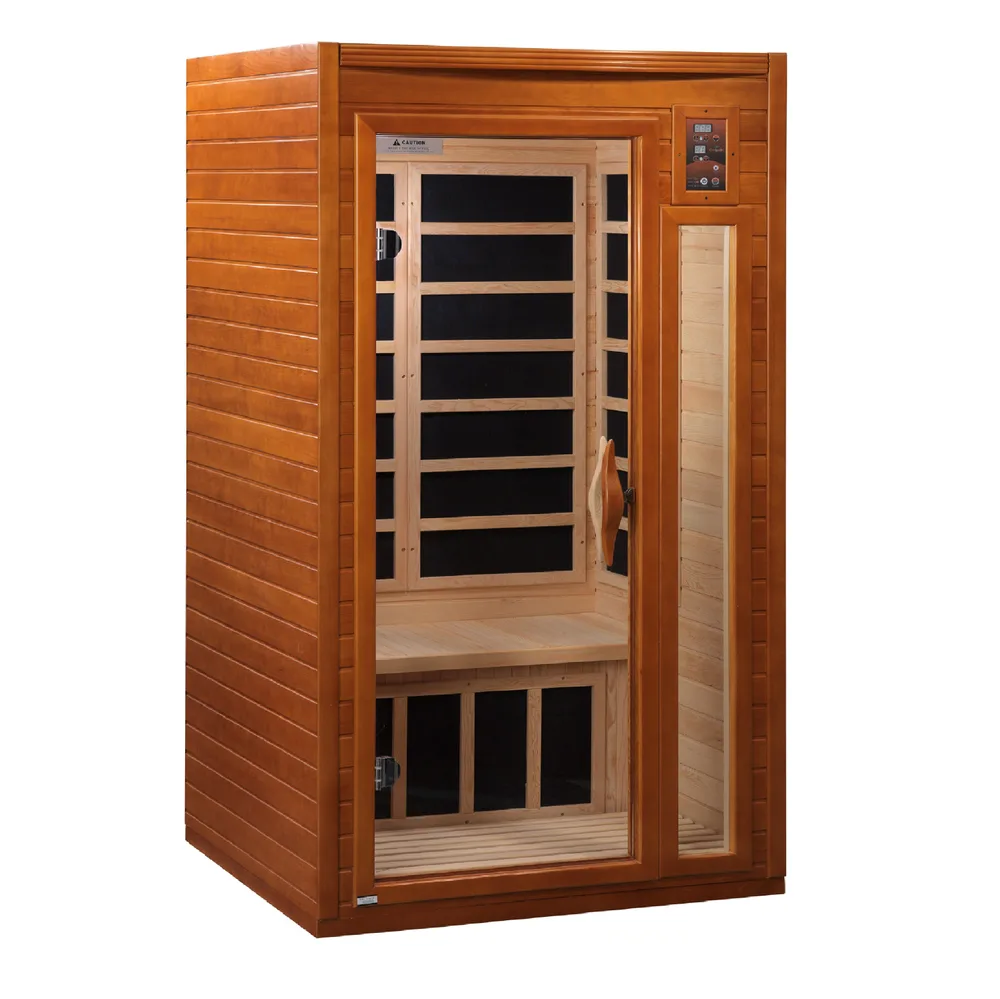
Most one-to-two person infrared cabins stay on 120V power, though the fine print varies more than the marketing suggests. Golden Designs’ Dynamic and Maxxus cabins are the friendliest case, rated 120V/15A plug-and-play with a dedicated outlet recommended, so they work with the receptacles most homes already have.
The class as a whole asks a bit more. Sauna electrical guides hold that most quality 1-2 person infrared cabins want a dedicated 20-amp circuit with a NEMA 5-20R receptacle, the 20-amp version of a standard wall outlet. Some higher-output 120V models draw over 23 amps and require a 30-amp locking receptacle, which usually means an electrician visit despite the 120V label on the box. The lesson: never stop reading at the voltage. Find the amp draw and the receptacle type on the spec sheet before checkout, then walk to your panel and see what the intended circuit already feeds.
240V territory: traditional stone heaters
Traditional electric sauna heaters run from 3 kW to 9 kW, and most home units need a 240V dedicated circuit in the 30 to 50 amp range. The typical install is a 40-amp, 2-pole breaker with the heater hardwired rather than plugged in, which means hiring a licensed electrician.
The ALEKO Liatris barrel sauna makes a concrete example. Its 4.5 kW Harvia KIP heater requires that dedicated 240V circuit before the first session, on top of an 880-pound freight delivery and an assembly that owners report takes two people 10 to 12 hours. None of that is a knock on the sauna. Stone heaters are the only route to genuine Finnish-style sessions, with traditional saunas running 150 to 195 F against the 120 to 140 F of infrared cabins, plus the option of ladling water over the stones. The point is budgeting: the wiring is a real cost that belongs in the comparison from the start, and it applies to nearly every heater in this class.
The cheat sheet
| Sauna class | Example | Power draw | What your wiring needs |
|---|---|---|---|
| Sauna blanket | HigherDOSE | 350-420W on 100-120V | Any household outlet |
| Fabric tent | SereneLife SLISAU10BK | Standard 120V | Any household outlet |
| Infrared cabin, entry | Dynamic Barcelona, Maxxus Toulouse | 120V/15A | Standard outlet, dedicated recommended |
| Infrared cabin, higher output | Varies by model | 120V, 20 to 23+ amps | Dedicated 20A (NEMA 5-20R) or 30A locking receptacle |
| Traditional stone heater | ALEKO Liatris, 4.5 kW Harvia | 3-9 kW class on 240V | Dedicated 30-50A circuit, hardwired |
Get the quote before the sauna
For any 240V unit, and for any 120V cabin that wants more than a 15-amp circuit, get the electrician’s quote before you order. The cost of a new circuit depends on your panel and your site, and only a quote tells you the real number. Ordering an 880-pound barrel first and discovering the wiring bill second is the wrong order of operations.
As for who lands where: renters and small-space buyers should stay in the plug-in tier, meaning blankets, tents, and 120V/15A cabins like the Golden Designs models. Homeowners set on real stone-heater sessions should price the 240V circuit as part of the sauna’s cost rather than a footnote, and in exchange they get the high-heat, wet-or-dry experience infrared cannot deliver. Everyone in between can take comfort in how much of today’s market runs on a normal plug, with nothing but an outlet standing between a bare corner and a warm one.
Questions, answered once
Can I plug an infrared sauna into a regular outlet?
Often, yes. Golden Designs' Dynamic and Maxxus cabins run on a standard 120V/15A plug with a dedicated outlet recommended. Some higher-output 120V cabins draw over 23 amps and need a 20A or 30A receptacle, so confirm the amp draw on the spec sheet first.
Why do saunas need a dedicated circuit?
A sauna heater draws near its full rating for an entire session, and sharing the breaker with other outlets or lights invites nuisance trips. Guidance for both 120V and 240V saunas says the heater should be the only load on its circuit.
What circuit does a traditional sauna heater need?
Home stone heaters run 3 to 9 kW and typically need a 240V dedicated circuit between 30 and 50 amps, commonly a 40-amp 2-pole breaker with the heater hardwired. Plan on a licensed electrician for the install.
Do sauna blankets require any special wiring?
No. The HigherDOSE blanket draws 350 to 420 watts on any standard 100-120V household outlet. It asks no more of your wiring than a small countertop appliance.