What red light panel controls buy you at each tier
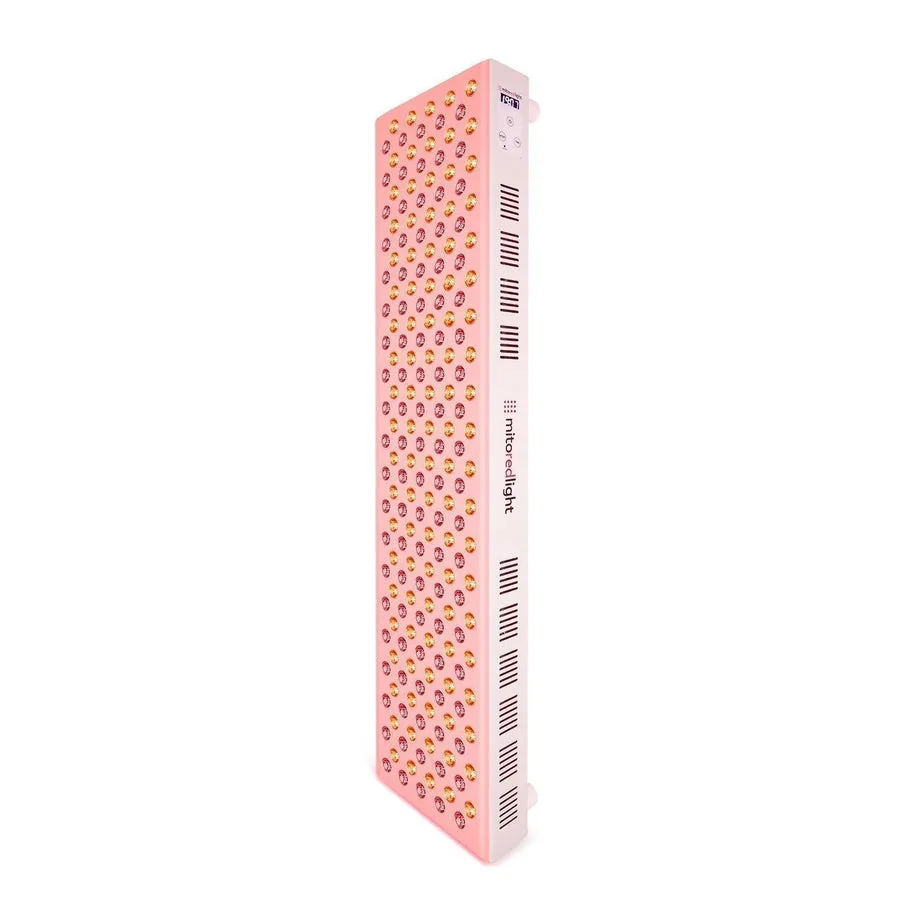
Walk through any red light panel comparison thread and you will see people arguing about irradiance, LED counts, and wavelength pairs. Almost nobody asks about the control hardware, even though the timer, the brightness settings, and the mode switch are the parts you touch every day you own the thing. Control features also happen to track price tiers cleanly, which makes them a useful shorthand for what a panel really is. This guide walks the tiers from a one-button torch up to towers that switch their red and near-infrared channels independently.
Auto shut-off is free now
Session timers have become effectively universal across the category. Wolezek’s budget 48W panel, one of the cheapest units on Amazon, ships with a controller offering a 5, 10, 15, 20, or 30-minute auto-off timer, five brightness levels from L0 to L4, and a pulse function. Bestqool’s compact BQ60 runs its timer through touch controls. Mito’s premium MitoMAX 2.0 builds a three-mode timer into the panel. When the bottom of the market includes auto shut-off, no panel at any price deserves credit for having one. Treat a missing timer as a reason to keep shopping, not as a reasonable trade-off.
Around $100, one button does everything
Handhelds keep controls to the bare minimum. LifePro’s LumiCure Torchlight runs on one-button operation with a 5-minute auto shut-off per session. You press the button, the light runs, and it turns itself off. There are no channels to switch and no brightness to set, and for a device you hold in your hand, that restraint reads as a feature rather than a shortcoming.
The surprise in this tier is how much the cheap panels include. That Wolezek controller’s five dimming levels and pulse function outclass the control hardware some pricier panels shipped a few years back. Independent testing has poked at this tier’s build quality with mixed results; GembaRed measured high close-range EMF on one budget Wolezek device, then found it dropped to near zero at a 6-inch distance.
Just under $200, touch controls and kickstands
Compact 60-LED panels from Hooga and Bestqool anchor the mid-tier. The Bestqool BQ60 pairs touch controls with an auto timer, and Bestqool claims 0 EMF at 6 inches. These panels weigh roughly 5 to 6 pounds and sit on kickstands or hang from door hooks, so the control story extends to placement: you can move one from desk to door in seconds. Protective goggles come in the box with most mainstream panels at this level, including the Hooga HG300 and the BQ60, and you should actually wear them, because these arrays are bright.
Premium towers separate red from near-infrared
The control feature that genuinely distinguishes the $700-and-up tier is independent channel switching. The MitoMAX 2.0’s built-in timer runs three modes: 660nm red only, 850nm near-infrared only, or both at once. Megelin’s full-length tower switches its red and NIR channels independently as well. On cheaper hardware, both wavelength groups fire together whenever the panel is on, so if you want the option of running a single wavelength by itself, this is the tier where it lives.
Towers bring logistics with them. A 200 to 300-LED unit weighs 20 to 25 pounds and relies on a hanging kit or a floor stand, and Megelin sells its horizontal stand as a separate purchase that costs more than an entire compact panel.
Beyond the standard pair
Nearly every mainstream panel builds on the same two wavelengths, 660nm red plus 850nm near-infrared, in an even LED split. Hooga’s ULTRA360 line steps past that with four wavelengths, 630, 660, 810, and 850nm, along with adjustable brightness and a pulse mode, per its Amazon listing. More channels mean more switching decisions, and the top of the market is where that control arms race is currently playing out.
The half-dark panel is fine
One fact will save you a pointless return: 850nm near-infrared light is invisible to the human eye. Run a panel in NIR mode, or in the combined mode on a 50/50 panel, and only about half the chips appear lit. Wolezek states this directly on its listing, and misreading it is the most common “defective panel” complaint in owner reviews across the category. Check which mode you are in before boxing anything up.
Where the money should actually go
Rank the features by what they cost against what you get. Timers cost nothing, since every tier has them. Brightness levels and pulse functions show up from the budget tier onward, so they should not command a premium either. Independent red/NIR switching is a genuine premium feature, but pay for it only if you specifically want to run one channel alone; on cheaper panels everything fires together and plenty of owners never miss the option. The spec that deserves more attention than any control is the warranty, which runs from 1 year at Megelin through 2 years at Bestqool and Mito Red Light to 3 years with a 60-day trial at Hooga. A dead controller three years in is a control-hardware problem no touch interface can offset.
Questions, answered once
Do budget red light panels come with timers?
Yes. Even Wolezek's cheap 48W panel includes a controller with a 5 to 30-minute auto-off timer, five brightness levels, and a pulse function. Auto shut-off is standard at every price now, so never pay extra for it.
What is pulse mode on a red light panel?
It is a control setting that cycles the LEDs on and off rapidly instead of holding steady output. It appears on budget Wolezek controllers and on Hooga's four-wavelength ULTRA360 line, so it is a feature of the control hardware rather than a premium exclusive.
Why do only half the LEDs light up in NIR mode?
Because 850nm near-infrared light is invisible to the human eye, so those chips look dark while running. The panel is working as designed. This is the most common false defect complaint in owner reviews.
Is independent red and NIR switching worth paying for?
Only if you want to run one wavelength by itself. Premium units like the MitoMAX 2.0 and Megelin's towers offer separate channel control, while cheaper panels fire both wavelength groups together whenever they are on.